One Sky - 12 Months, but 3 Methods of Indian Calculation
September 18, 2026
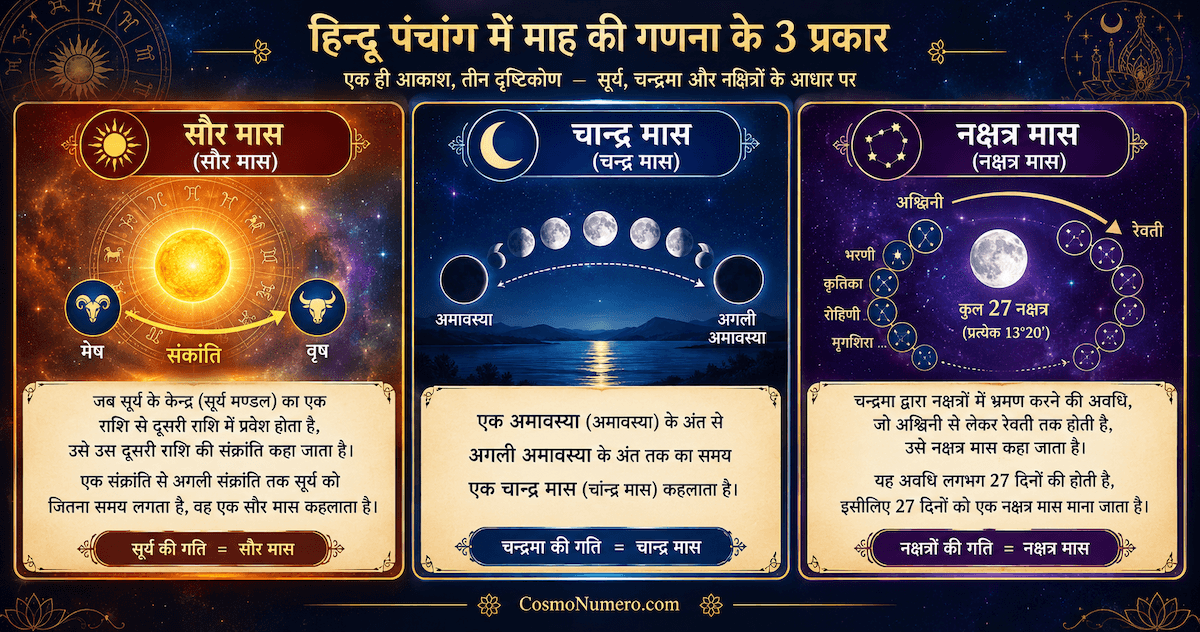
Month / मास / माह / महीना Understanding the Hindi month (Hindi Maas / हिन्दी मास) is a bit complex—essentially, festivals are celebrated by observing the lunar month (Chandramaas / चन्द्र मास). This is the most prevalent practice. Apart from this, there are also sidereal months (Nakshatra maas / नक्षत्रमास), solar months (Saur maas / सौरमास), and intercalary months (Adhimaas / अधिमास). In fact, the Hindu Panchang is based on the constellations (Nakshatras), the Sun, and the Moon. The lunar dates (tithis) are based on the Moon, while the days are based on the Sun. Let us explore the key aspects of the Hindi month. There are 12 months in the Hindi lunar calendar. These 12 months are named after specific constellations (Nakshatras). The single month formed by the two fortnights (Krishna Paksha and Shukla Paksha), which represent the waxing and waning phases of the Moon, is what we call a lunar month. Depending on the increase or decrease of the lunar date (tithi), this month can last for 29, 30, 28, or even 27 days. This is why an intercalary month (Adhimaas) occurs every 3 years to balance the calendar. Solar Month (सौर मास): When the center of the solar disc enters from one zodiac sign into another, it is called the Sankranti (transit) of that second sign. The time taken by the Sun to travel from one Sankranti to the next Sankranti is called one solar month. Since the angular velocity of the Sun does not remain uniform, there is a slight variation in the duration of each solar month. When the angular velocity is higher, the Sun crosses a zodiac sign quickly, making that solar month shorter. Similarly, when the angular velocity of the Sun is lower, the solar month is longer. The average duration of a solar month is 30.438 days. Lunar Month (चान्द्र मास): When the longitudes of the Sun and the Moon become identical, it marks the end of the Amavasya (New Moon) tithi. The time period from the end of one Amavasya(अमावस्या) to the end of the next Amavasya is called one lunar month. This is also known as a Synodical month. It is equal to 29.5306 average solar days. 1. Chaitra: This month is named after the Chitra nakshatra (lunar mansion) because its full moon (Purnima) always falls on either the Chitra or Swati nakshatra. During this month, the transit of the Sun is in Aries (Mesha). It features the Vasant (spring) season. 2. Baishakh: This month is named after the Vishakha nakshatra because its full moon always falls on either the Vishakha or Anuradha nakshatra. During this month, the transit of the Sun is in Taurus (Vrishabha). Following the spring season, the Grishma (summer) season begins in this month. 3. Jyeshtha: This month is named after the Jyeshtha nakshatra because its full moon always falls on either the Jyeshtha or Mula nakshatra. During this month, the transit of the Sun is in Gemini (Mithun). It features the Grishma (summer) season. 4. Ashadh: This month is named after the Purvashadha and Uttarashadha nakshatras because its full moon always falls on either the Purvashadha, Uttarashadha, or Shatabhisha nakshatra. During this month, the transit of the Sun is in Cancer (Kark). After summer lasting for half of the month, the Varsha (monsoon/rainy) season begins. 5. Shravan: This month is named after the Shravan nakshatra because its full moon always falls on either the Shravan or Dhanishta nakshatra. During this month, the transit of the Sun is in Virgo (Kanya). It features the Varsha (monsoon/rainy) season. 6. Bhadrapad: This month is named after the Purva Bhadrapad or Uttara Bhadrapad nakshatras because its full moon always falls on either the Purva Bhadrapad or Uttara Bhadrapad nakshatra. During this month, the transit of the Sun is in Leo (Simha). It features the Varsha (monsoon/rainy) season. 7. Ashwin: This month is named after the Ashwini nakshatra because its full moon (Purnima) always falls on either the Ashwini, Revati, or Bharani nakshatra. During this month, the transit of the Sun is in Libra (Tula). It features the transition from the rainy season to the Sharad (autumn) season. 8. Kartik: This month is named after the Krittika nakshatra because its full moon always falls on either the Krittika or Rohini nakshatra. During this month, the transit of the Sun is in Scorpio (Vrishchik). It features the Sharad (autumn) season. 9. Margashirsha: This month is named after the Mrigashira nakshatra because its full moon always falls on either the Mrigashira or Ardra (referred to as Uttara in the text) nakshatra. During this month, the transit of the Sun is in Sagittarius (Dhanu). It features the Hemant (pre-winter) season. 10. Paush: This month is named after the Pushya nakshatra because its full moon always falls on either the Punarvasu or Pushya nakshatra. During this month, the transit of the Sun is in Capricorn (Makar). It features the Hemant (pre-winter) season. 11. Magh: This month is named after the Magha nakshatra because its full moon always falls on either the Magha or Ashlesha nakshatra. During this month, the transit of the Sun is in Aquarius (Kumbha). It features the Shishir (late winter/frost) season. 12. Phalguna: This month is named after the Purva Phalguni or Uttara Phalguni nakshatras because its full moon always falls on either the Purva Phalguni, Uttara Phalguni, or Hasta nakshatra. During this month, the transit of the Sun is in Pisces (Meen). It features the Shishir (late winter) season. Names of Solar Months (Sauramas / सौरमास): Aries (Mesha), Taurus (Vrishabha), Gemini (Mithun), Cancer (Kark), Leo (Simha), Virgo (Kanya), Libra (Tula), Scorpio (Vrishchik), Sagittarius (Dhanu), Aquarius (Kumbha), Capricorn (Makar), and Pisces (Meen). Sidereal / Constellation Month (Nakshatra Mas / नक्षत्र मास): The period during which the Moon transits through the nakshatras (lunar mansions) starting from Ashwini all the way to Revati is called a Nakshatra Month. This lasts for approximately 27 days, which is why a period of 27 days is known as one Nakshatra Month. Planetary Lords (Rulers) of the Nakshatras: Ketu: Ashwini, Magha, Mula Venus (Shukra): Bharani, Purva Phalguni, Purvashadha Sun (Ravi): Krittika, Uttara Phalguni, Uttarashadha Moon (Chandra): Rohini, Hasta, Shravan Mars (Mangal): Mrigashira, Chitra, Dhanishta Rahu: Ardra, Swati, Shatabhisha Jupiter (Brihaspati): Punarvasu, Vishakha, Purva Bhadrapad Saturn (Shani): Pushya, Anuradha, Uttara Bhadrapad Mercury (Budh): Ashlesha, Jyeshtha, Revati