Breath Science: The Wisdom of Breath Awareness and its Connection to Human Health
September 15, 2026
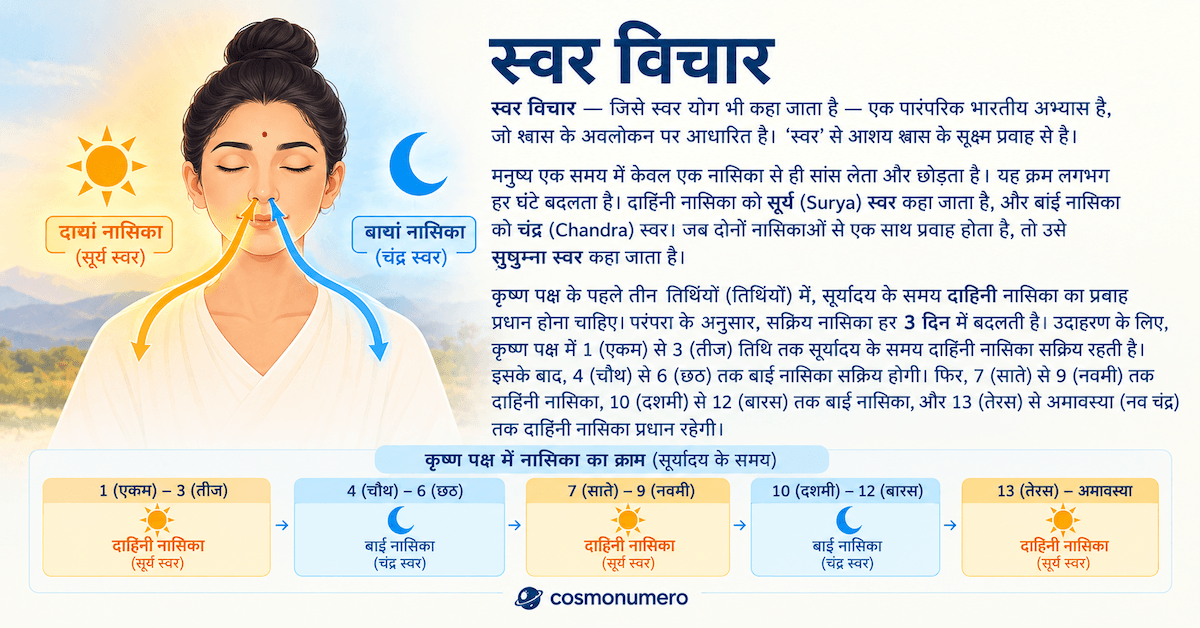
Swar Vichar—also known as Swar Yoga—is a traditional Indian practice based on the observation of the breath. ‘Swar’ refers to the subtle flow of breath. A human being breathes in and out through one nostril at a time. The sequence shifts approximately every hour. The right nostril is called the Surya (Sun) swar, and the left nostril is called the Chandra (Moon) swar. When both nostrils flow simultaneously, it is called the Sushumna swar. During the first three dates (Tithis) of the waning phase of the moon (Krishna Paksha), the right nostril should be dominant at sunrise. Tradition dictates that the active nostril changes every 3 days. For instance, in the Krishna Paksha, the right nostril remains dominant at sunrise from the 1st (Ekam) to the 3rd (Teej) date. Consequently, from the 4th (Chauth) to the 6th (Chhath), the left nostril will be active at sunrise. Then, from the 7th (Saate) to the 9th (Navmi), the right nostril returns; from the 10th (Dashmi) to the 12th (Baras), the left nostril; and from the 13th (Teras) to the New Moon (Amavasya), the right nostril will be dominant. This pattern continues regularly. The sunrise date (Udaya Tithi) is considered standard for this cycle. If a date is shortened in the lunar calendar, the pattern shifts in two days, and if a date is extended, it shifts in four days. For your convenience, a 🌙 symbol will be placed next to dates when the left nostril should be active, and a ☀️ symbol will be placed next to dates when the right nostril should be active in the future. In traditional beliefs, balancing these breaths is considered crucial for health. Correct any irregularity in your breathing flow. If you find a reverse flow active, make a small ball out of a clean, washed piece of muslin cloth and plug that particular nostril to close it. Continue this practice for 24 hours. If the breath does not flow correctly the next day either, keep the nostril closed for 48 or 72 hours respectively. Change the cloth ball every two hours. During these days, one should avoid heavy labor, intoxication, and running. If any practice causes discomfort, dizziness, or uneasiness, stop it immediately. बांई करवट सोइये, जल बांये स्वर पीव। दाहिने स्वर भोजन करें, तो सुख पावे जीव ॥1॥ दिन में चाले चन्द्रमा रात चलावें सूर। तो निश्चय कर मानिये प्राण गमन अति दूर ॥2॥ 1. Morning: You should get out of bed from the side of the active nostril. 2. When the Right Nostril is Active: Perform activities such as defecation, bathing, eating, reciting mantras, worship, writing letters, studying, intimacy, going to war, traveling to the East and North, buying vehicles, and taking medicine. 3. When the Left Nostril is Active:Perform stable or permanent tasks, marriage, receiving a guru mantra, practicing yoga, farming, preparing divine medicines, building gardens or water tanks, expressing affection, traveling to the South and West, and consuming liquids like milk, tea, medicine, and water. 4. Sushumna Swar: This flows during the transition period between the shifting of nostrils, when one's end is near, or when a specific accident or negative outcome is imminent. During such times, one should only pray and chant God's name. 5. Travel Considerations: Travel toward the East, North, Northeast (Ishan), and Southeast (Agnikona) when the right nostril is active. Travel toward the South, West, Southwest (Nairutya), and Northwest (Vayavya) when the left nostril is active. 6. Relieving Bodily Discomfort: If you experience any physical pain or discomfort at any time, closing the currently active nostril and activating the other one helps alleviate the distress. 7. Whoever keeps the Moon active during the day and the Sun at night enjoys longevity and remains free from the effects of poison, sorcery, etc.9. Pay close attention to your active nostril at sunrise on Chaitra Shukla 1 (the Hindu New Year). If the breath is irregular at this time, there is a possibility that the entire year may go poorly. ✨ In traditional beliefs, balancing these breaths is considered crucial for health. Swar science begins with a small practice of awareness: breathe naturally, observe clearly, and allow a little more balance into this moment.