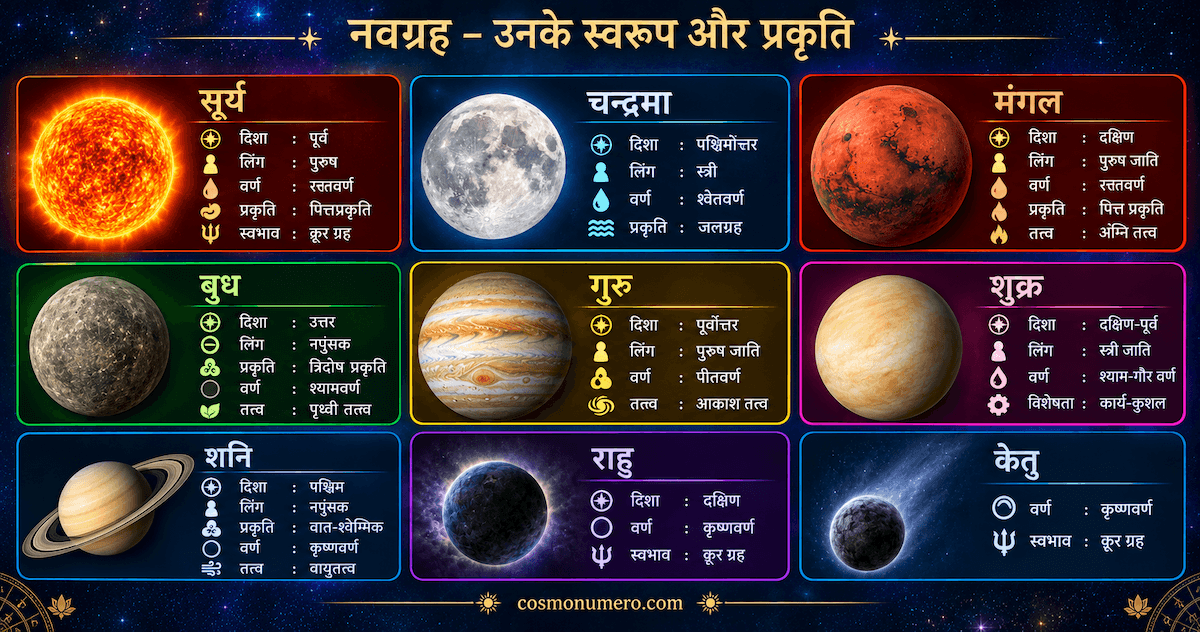
The Nine planets (Grahas) and Their Nature
September 8, 2026
In astrology, a birth chart is read through nine Grahas; let's see what each one signifies: Surya (Sun): Lord of the east, masculine, blood-red in colour, of bilious (Pitta) nature, and a cruel (malefic) Graha. Surya signifies the soul, temperament, health, sovereignty, and places of worship, and is the significator (karaka) of the father - matters concerning the father are read from it. It has a particular influence on the eyes, liver, spine, and nerves. It's considered strong (Bali) in the seventh house from the Lagna, and strong in motion (Cheshtabali) through the six signs from Capricorn; from it, one reads bodily ailments, headaches, indigestion, wasting disease, high fever, and dysentery. Chandra (Moon): Lord of the north-west, feminine, white in colour, and a watery Graha. Its humour is Vata-Kapha, and it governs the blood. It's the karaka of parents, disposition, physical vigour, royal favour, wealth, and the fourth house. The Moon is strong in the fourth house, and has Cheshtabal through the six signs from Capricorn. From it, one reads bodily illness, anaemia, watery and phlegmatic diseases, urinary disorders, women's ailments, mental illness, aimless wandering, the abdomen, and the mind. From the sixth day of the dark fortnight to the tenth day of the bright fortnight, the Moon is waning and is treated as a malefic; from the tenth day of the bright fortnight to the fifth day of the dark fortnight, it's full of light and is treated as benefic and strong. Only a strong Moon gives its full result in the fourth house. Mangal (Mars): Lord of the south, masculine, of bilious (Pitta) nature, blood-red in colour, and of the fire element. It is malefic by nature, and rules courage and valour. It's strong in the third and sixth houses, and yields no result (Nishphal) in the second. It has Digbal in the tenth house, and Cheshtabal when placed with the Moon. It's the karaka of brothers and sisters. Budh (Mercury): Lord of the north, neuter, of tridoshic nature, dark-complexioned, and of the earth element. It gives inauspicious results when placed with malefic Grahas - Surya, Mangal, Rahu, Ketu, Shani - and auspicious results when placed with benefic Grahas - a full Moon, Guru, Shukra. It's the karaka of astrology, medicine, craft, law, commerce, and the fourth and tenth houses. It yields no result when placed in the fourth house. From it, one reads the tongue, palate, and other organs of speech, and especially speech itself, genital disorders, chronic dysentery, confusion of intellect, muteness, laziness, wind-disorders (Vata), and leukoderma. Guru (Jupiter): Lord of the north-east, masculine, yellow in colour, and of the ether (space) element. It's strong in the Lagna, and has Cheshtabal when placed with the Moon. It increases fat and the Kapha humour. From it, one reads sons, grandsons, learning, home, abdominal tumours, and swelling (inflammation). Shukra (Venus): Lord of the south-east, feminine, dark-fair in colour, and skilled in action. Under this Graha's influence, the native's complexion tends toward wheatish. It yields no result in the sixth house, and is inauspicious in the seventh. It's a watery Graha, so it's considered the karaka of Kapha, semen, and similar bodily fluids. It's the karaka of desire for pleasure, the art of music, poetry, flowers, ornaments, the eyes, vehicles, the bed, women, and verse. If birth occurs during the day, it's read for the mother. Worldly happiness is read from this Graha above all. Shani (Saturn): Lord of the west, neuter, of Vata-Kapha nature, dark in colour, and of the air element. It's strong in the seventh house, and has Cheshtabal when retrograde or placed with the Moon. From it, one reads proficiency in English learning. If birth occurs at night, it becomes karaka for both mother and father. From it, one reads lifespan, physical strength, generosity, adversity, the practice of Yoga, dominion, prosperity, liberation (Moksha), fame, employment, and fainting-spells and similar ailments. Rahu: Lord of the south, dark in colour, and a cruel (malefic) Graha. Whichever house it occupies, it obstructs the progress of that house. Ketu: Dark in colour and a cruel (malefic) Graha. From it, one reads skin disease, the maternal grandfather, the hands and feet, and afflictions born of hunger. A special note - although both Brihaspati (Jupiter) and Shukra are benefic Grahas, worldly and practical pleasures are read from Shukra, while otherworldly and spiritual pleasures are read from Brihaspati. Under Shukra's influence, a person becomes self-interested; under Brihaspati's influence, a person becomes altruistic. Shani and Mangal are both malefic Grahas too, but the difference between the two is this: although Shani is a cruel Graha, its ultimate result is pleasant - it purifies a person by putting them through misfortune and hard counsel. Mangal, however, is always distressing, since it excites, and fills one with restlessness and craving. Among the Grahas, Surya and Chandra are the king, Budh is the crown prince, Mangal is the commander-in-chief, Shukra-Guru are the ministers, and Shani is the servant. A strong Graha remakes the native in its own image. Surya is the symbol of strict discipline, ego, authority, and order. It gives no one any leeway, which is why people mistake its stern nature for something wrong. ✨ Every Graha speaks a truth your soul chose - know which Graha runs strongest in your own chart, and you'll know exactly where and how your life is urging you to move forward.