Choghadiya: How to read the day’s 16 traditional time windows
September 10, 2026
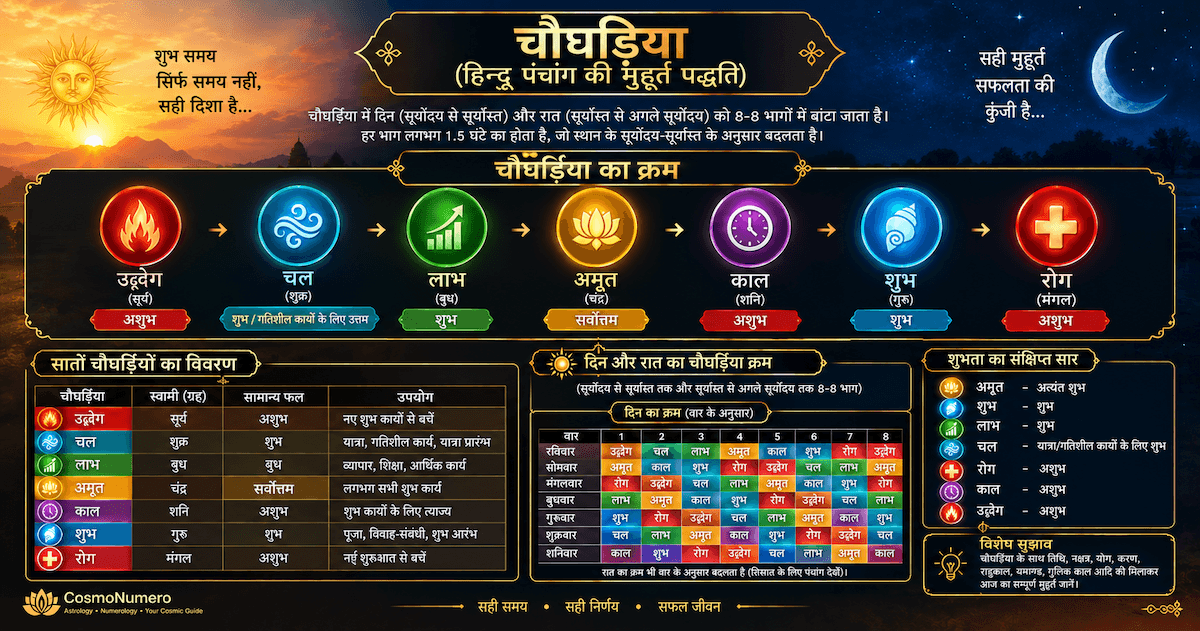
Choghadiya is a practical, day-to-day timing guide. It does not select a personalised muhurat from a birth chart. Instead, it helps a person quickly choose a suitable period for ordinary beginnings—such as travel, a purchase, study, business work, or a routine ceremony—when a more detailed muhurta is not being used. A local day has 16 Choghadiya windows: eight from sunrise to sunset and eight from sunset to the following sunrise. Each half is divided into eight equal durations. That is why a Choghadiya is not always 90 minutes: in summer, daytime windows are longer and night windows shorter; in winter, the reverse is true. The correct timings therefore depend on the place, date, local sunrise, and local sunset. The seven names repeat in a fixed order: Udveg → Chal → Labh → Amrit → Kaal → Shubh → Rog. The weekday determines where the daytime and night-time lists begin, and because there are eight windows but seven names, the eighth repeats the first. The night list uses the same repeating order but begins at its own weekday-specific position; it should not simply be treated as a continuation of the daytime list. Traditionally, Amrit, Shubh, and Labh are preferred for beginning favourable work. Labh is often associated with gain, commerce, and learning; Shubh with auspicious or ceremonial work; and Amrit with broadly favourable beginnings. Chal (also written Char) is considered movable or neutral and is commonly used for travel and routine tasks. Rog, Kaal, and Udveg are generally avoided for important new starts. Choghadiya is one layer of a Panchang, not a complete decision on its own. A day may also show Rahu Kaal, Yamaganda, or Gulika Kaal. When one overlaps an otherwise favourable Choghadiya, the name of that Choghadiya does not change — but the overlapping Kaal is a separate caution. For a major event such as marriage, Griha Pravesh, or a high-stakes business launch, consult the full Panchang rather than relying only on these daily windows. ✨ Read Choghadiya as a simple local rhythm for the day: check the active or upcoming window, prefer the traditionally favourable categories where practical, and treat it as guidance rather than certainty.